






EC replaces digital draft voter lists in Bihar with scanned images that make finding errors harder
Data on digital rolls can be extracted and organised quickly using computer programmes and artificial intelligence tools.

The Election Commission on Saturday replaced the digital draft voter lists in Bihar with scanned images of the voter lists on its official websites.
The digital draft lists are machine-readable and easier to analyse for errors and patterns on a large scale. The scanned versions make this process harder.
This came two days after Congress leader Rahul Gandhi alleged that the poll panel has refused to share digital voter lists because it could expose dubious and fake voters who allegedly help the Bharatiya Janata Party win elections.
Scroll contacted an Election Commission official for comment. The story will be updated if the official responds.
The Bihar draft voter lists were released on August 1 after the poll body finished the first phase of the special intensive revision of voter lists in the state, removing more than 65 lakh voters. It alleged that these voters were either dead, already enrolled or had shifted permanently.
Bihar’s draft roll has 90,712 voter lists, with names of 7.2 crore voters, according to the Election Commission.
On August 1, the poll panel had uploaded voter lists on two different websites.
One is the Voter Services Portal, which allows all users to download any voter list across the country in batches of 10.
The second is a dedicated website called “Bihar SIR Draft Roll 2025” that contains Assembly constituency-wise zip files. Each zip file contains every voter list in the constituency.
Between August 2 and August 5, Scroll had downloaded voter lists from both websites. These lists were in a digital machine-readable format.
The Election Commission stores voter lists in PDF format, whether digital or scanned. Digital rolls allow for easier access because they are searchable. A voter can easily look up any name or voter ID number in these lists, which are usually 20 pages to 40 pages long.
The digital rolls also allow for greater scrutiny because its data can be extracted and organised using computer programmes and artificial intelligence tools in a short span of time.
On August 6, the Election Commission removed the digital voter lists from the Voter Services Portal and replaced them with scanned images.
The scanned format is like an image of the voter list. It is not searchable and it is much harder to scrape data from it. These files are bigger in size, have low resolution, and the extraction of data takes much longer and is prone to errors.
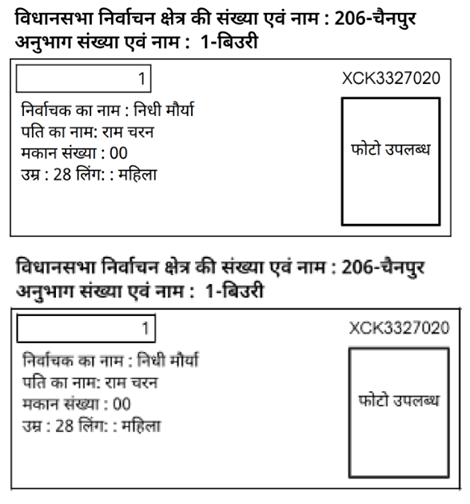
Even after the Election Commission replaced the voter lists on the Voter Services Portal, the dedicated website still provided digital lists.
On August 7, Gandhi organised a press conference and accused the poll panel of creating dubious voter lists in an Assembly constituency in Karnataka. The Assembly constituency of Mahadevapura is one of the eight Assembly segments that form the Bangalore Central Lok Sabha seat, which the BJP had won by a significant margin in the 2024 Lok Sabha elections.
He alleged that at least one lakh voters in the Mahadevapura Assembly constituency were “fake” – dozens of them were allegedly registered at the same address, or at addresses such as “0”, or were also included in voter lists in other parts of the country.
Gandhi said that the Congress had to sift through thousands of pages of voter lists in the constituency for six months because the poll panel refused to share the data in a digital machine-readable format.
In June, an unidentified Election Commission official had declined Gandhi’s requests for digital voter lists on the ground that it was “not tenable within the contours of the prevailing legal framework”, PTI reported.
On Saturday, the Election Commission also removed digital voter lists from the “Bihar SIR Draft Roll 2025” website.
The revision of the electoral rolls in Bihar was announced by the Election Commission in June.
As part of the exercise, persons whose names were not on the 2003 voter list needed to submit proof of eligibility to vote.
A Scroll analysis of the data published by the Election Commission on August 1 showed that women made up 55% of voters who were excluded from Bihar’s draft voter list after the revision.
It also showed that five of the state’s 10 districts with the largest share of Muslim population had the highest number of excluded voters.
Also read:
- Bihar roll revision: Muslim-dominant areas trail in filling enumeration forms, EC data shows
- Highest exclusion in Bihar draft roll: Women, Muslim-dominant districts
